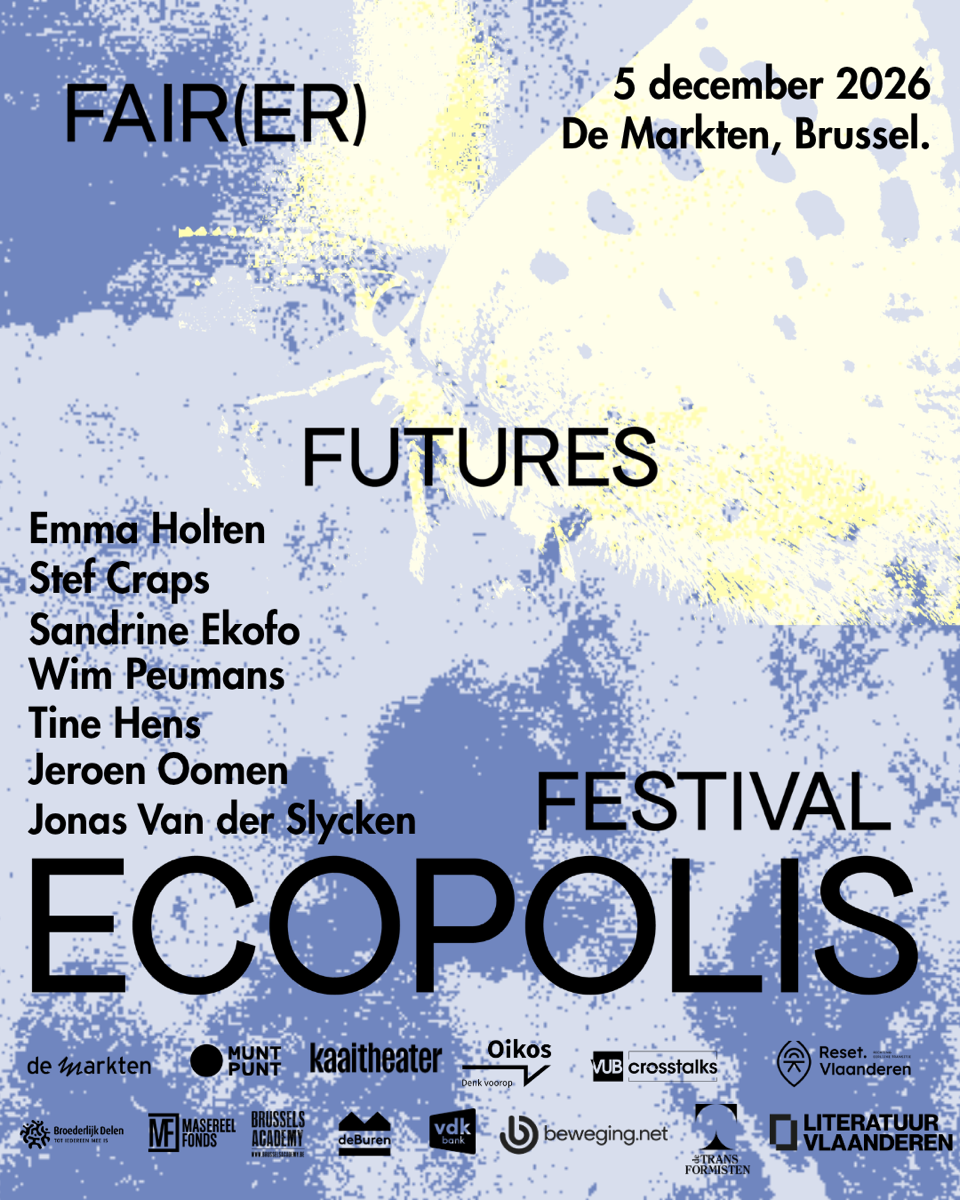
Emma Holten Tine Hens Sandrine Ekofo Wim Peumans Jeroen Oomen Jonas Van der Slycken Stef Craps
ECOPOLIS
On December 5, ECOPOLIS, Fair(er) Futures Festival will once again bring together thinkers and doers, writers, artists, and activists from various countries for a day filled with inspiring conversations, hopeful ideas, and new perspectives.
After all, we live in a time of great challenges: think of climate disruption and growing inequality. This raises numerous questions. How do we build a future that works for everyone again? And what do we need to envision—and also shape—that future?
We ask the big questions—such as the one posed by Anna Tsing: What is the art of living on a damaged planet? Questions that have become all too real in the face of extreme heat waves and wildfires. And they show that, ultimately, this is a matter of justice—not only here but also in the Global South. Because those who contribute the least to ecological disruption are hit the hardest. Nepal is a painful example of this. And that’s what we need to talk about.
That’s why ECOPOLIS remains a place to stimulate your imagination and push boundaries. Because only if we can imagine a better society can we shape it.
THE PROGRAMME
Archive of Potential Loss
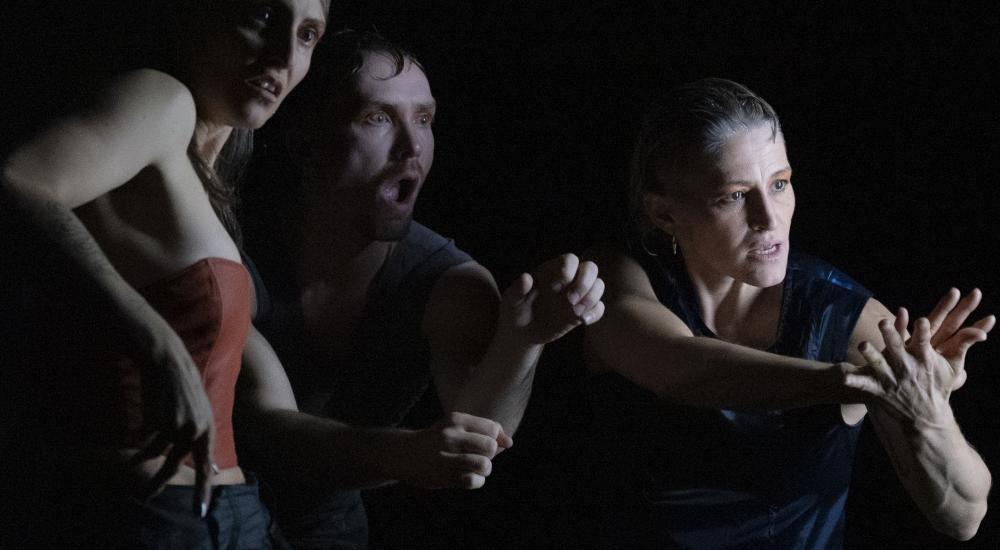
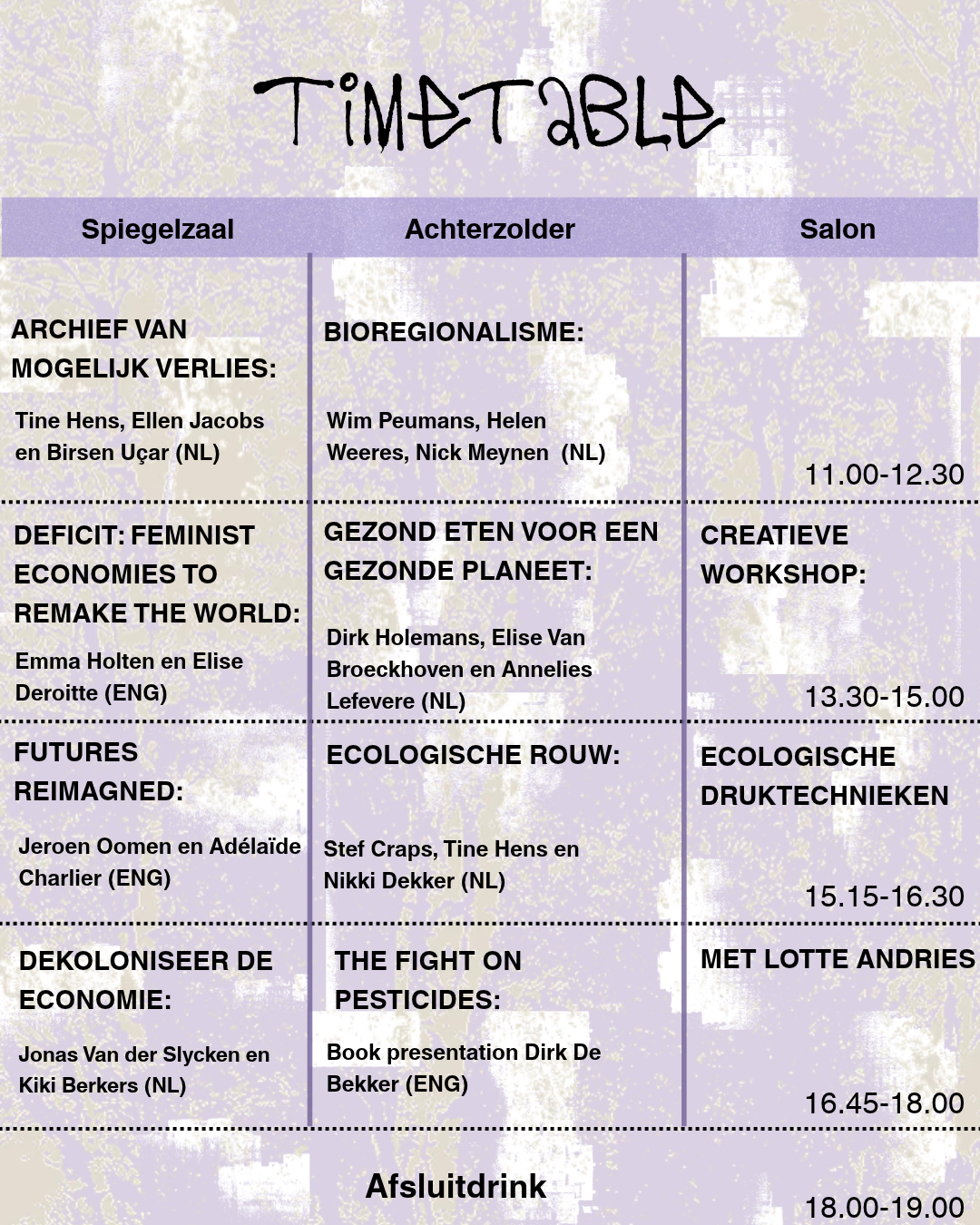
Over the past fifty years, wild animal populations have shrunk by almost three-quarters on average, mainly due to the way the wealthy world produces and consumes. What was once commonplace is becoming increasingly rare, and because we never experienced it, we forget how abundant all other life was not so long ago. In *Archive of Potential Loss*, Tine Hens pays tribute to the ordinary, everyday things that are so quietly slipping away. This performance weaves together literature, sound and song to confront us with what we are in danger of forgetting: from flocks of starlings to the pure experience of silence, snow and darkness. The performance takes you on a sensory journey that not only mourns what is disappearing, but also seeks a renewed connection with nature.
In her book Archive of Possible Loss, which won the 2026 Nature Book Prize, journalist and author Tine Hens brings together twelve compelling stories about plants, animals and natural phenomena that are on the verge of disappearing. She shares the stage with composer Ellen Jacobs, who has translated the stories into an original sound composition in which the sounds of melting glaciers, larks and the song of the midwife toad come together. The book launch will be brought to a close by musician and aspiring eco-philosopher Birsen Uçar, who, in her work and song lyrics, explores how humanity has become disconnected from nature and advocates for a deeper connection with non-human beings.
Bioregionalism: learning to live in a place once more
Building houses in floodplains shows just how alienated we have become from the landscape. But there is another way. As a movement, bioregionalism advocates relearning how to ‘live in a place’, to re-inhabit that place with an awareness of the landscape. This involves reorganising social structures around living systems such as river basins. A fascinating conversation with Helen Weeres, a poet and regenerative cultural practitioner who, through initiatives such as the Bodemzicht Foundation, brings together art, rituals and regenerative agriculture. Weeres engages in dialogue with Nick Meynen, a geographer working on climate transition at Leuven 2030 and co-editor of the bioregionalism feature in Oikos Magazine #120, and Wim Peumans, an anthropologist and author of the highly acclaimed book De Maas, in which he reveals the intimate connection between people, history and the ecology of a river basin.
Feminist Economics to Remake the World
Our current economic system is based on exploitation, with a clear link between the exploitation of unpaid care work and the depletion of our planet. That is why the speakers are making a strong case for a feminist economy that prioritises human and environmental wellbeing over market profits. Together, they explore how we can build a social framework in which care for both people and the planet is valued above all else.
Emma Holten introduces the vision set out in her groundbreaking book Deficit: How Feminist Economics Can Change the World. She shares the stage with Elise Derroitte, philosopher and vice-chair of the Christelijke Mutualiteit (CM), who uses her expertise to campaign for fairer healthcare systems and robust social protection for all.
Healthy eating for a healthy planet
Good news: if you choose to eat healthily, you are immediately helping to restore the health of our planet. In doing so, you are helping to accelerate the transition to an agro-ecological food system that frees our agriculture from the grip of the agro-industry. Numerous initiatives are already demonstrating how a sustainable and local alternative is taking shape through renewed, direct collaboration between citizens and farmers.
Dirk Holemans, author of Grondgenoten, advocates for a food system centred on care for people and nature. He will be in conversation with Annelies Lefevre, a passionate organic farmer who, following her Landwijzer training, helped set up the new pick-your-own field at the ‘t Uilenbos organic farm, and Elise Van Broeckhoven, an agro-ecological farmer who, through her pick-your-own farm Grondig, builds bridges between citizens, farmers and a biodiverse natural environment.
Futures Reimagined
This panel discussion explores how the collective imagination has become entangled in a narrow framework of technocratic solutions and ecological modernisation, leaving no room to explore truly alternative societies. What does it mean to radically reshape our collective future? How can we seek out alternative dramaturgies of change and new cultural approaches to liberate environmental politics?
Jeroen Oomen, lecturer (Utrecht University), is co-author of Captured Futures (2025), which examines how social and cultural practices shape visions of the future. He shares the stage with Adélaïde Charlier, co-executive director of the democratic innovation platform G1000 and co-founder of Youth for Climate, who draws on her expertise in citizen mobilisation to advocate for systemic political action and democratic renewal.
The Power of Ecological Mourning
This panel discussion explores the emotional impact of the climate crisis and the loss of nature. Stef Craps will talk to the authors about how the grief surrounding this can be channelled into collective care. Together, they will seek out language, rituals and new perspectives to give this emerging form of loss a place in our society.
Stef Craps is a professor of English literature (Ghent University) and, amongst other things, guest curator of the exhibition on ecological mourning, Tending Loss, at RADIUS in Delft. He will be in conversation with journalist and author Tine Hens, whose book Archief van mogelijk verlies (Archive of Possible Loss) won the Nature Books Prize, and Nikki Dekker, a writer and radio producer, who explores the boundaries between humans and nature in her work.
No decisive climate policy without a different economy
This panel discussion, taking as its starting point the link between large-scale extraction of raw materials and global climate disruption, focuses on the need for a fundamental systemic change. The speakers advocate an economic model that places global solidarity and climate justice at its heart. Together, they explore how we can begin the transition to a welfare economy that operates within the planet’s limits. A discussion that begins with a critical review of the UN Climate Change Conference COP31.
Kiki Berkers, policy officer for climate and natural resources at 11.11.11 and a delegate at the UN Climate Change Conference COP31 in Antalya, will be in conversation with Jonas Van der Slycken, author of Scandalously Rich or Unequal, who sets out concrete proposals demonstrating how we can organise an ‘economy of enough’ based on well-being, redistribution and ecological stability.
The fight against pesticides
European agriculture is heavily reliant on chemical inputs. This panel will shed light on the powerful political and corporate interests that drive the global agrochemical complex. The speakers will analyse how lobbyists prioritise corporate profits over public health and biodiversity, whilst also debating the urgent need for a systemic transition to sustainable agricultural practices that look after farmers, consumers and the natural environment.
Dirk de Bekker, an investigative journalist, wrote the book *Het pesticidenparadijs* (*The Pesticide Paradise*), in which he exposes the hidden reality of chemical agriculture based on extensive fieldwork and internal documents. He will be joined by Hans Van Scharen, a researcher and campaigner at Corporate Europe Observatory (CEO), which recently published a report showing how the pesticide industry’s wording has been adopted almost word for word in the EU’s proposal for a revision of the rules governing the authorisation of pesticides.