La Candidate
A project coordinated by Anna Rispoli, written down by Nina Ferrante
The Premises
On April 25, 2022, I was sitting in the audience at the Cirque Royale, listening to a multi-voiced conversation with Angela Davis. I had only recently moved to Brussels; I didn’t yet know most of the collectives, and the faces of the women from the Comité de femmes Sans-Papiers were still unfamiliar to me, their names were not yet part of the affective map I was beginning to trace in the city. They were there to open the event with the full force of their singing, launching a memorable exchange on the meaning of struggle and on how to organize and stand together against racist and patriarchal violence. Of the many things said that day, what I took home, and still stays with me, is a steadfast faith in utopia.
The writer, whose face has become almost symbolic of Black feminist struggle, did not recount the long path she had already walked. Instead, she turned our gaze far ahead, beyond the horizon of what seems possible, toward the futures we have yet to build — but for which it is already worth fighting. To practice activism from a long-term perspective does not mean placing faith in the illusory promise of progress, in the belief that things will eventually get better. The violent backlash sweeping over us today shows that no achievement can ever be taken for granted, no right is ever permanently secured, and, above all, that fascism is not merely a dark page of our past. And yet, when everything accelerates so rapidly and dystopia becomes the texture of daily life, this is the moment to stretch our gaze. To face the harshness of everyday violence, to stand firm amid constant emergencies, and to root our struggles deeply in utopia: to imagine what does not yet exist, and to fight to bring it into being.
This is the spirit that kindles the spark of Struggle Care Joy, the trajectory that Anna Rispoli inaugurated in 2024, weaving a web of sisterhood among sans-papiers women and their allies, in which I myself found I had become “entangled.” Anna is known as an artist who works along that delicate threshold where militant and artistic practices blur into one another. I have come to understand her work as a way of inhabiting the world, and transforming it. Most importantly, her artistic gesture is never hers alone. The very movement of her practice lies in making that gesture collective: in negotiating, together with others, a project, a vocabulary, needs and conflicts that allow a community to recognize itself as such.
The Trajectory of What Is Not Yet Here
In this work too, artistic practice unfolds as a performative act that constitutes the common: the shared space in which we can be present for one another. The trajectory, co-produced by Kaai and Kanal Pompidou, takes shape through the co-design of a series of prefigurative acts: actions in public space, but also workshops that aim to reclaim time – time to enjoy and time to organize – from the logic of emergency. Emergency should be an exception, while there is nothing exceptional about the structural racist violence in which we live; and in which, above all, our companions participating in the project live. This is why we attempt to co-design the collective as a space for mutual care: a place to care for oneself and for others, to build alliances, gather strength, and develop tools that can sustain the daily struggles of sans-papiers women to access healthcare, to secure a safe roof over their heads, to live a dignified life with their loved ones; but also to reclaim the time for leisure, the luxury of self-care, the love of friendship and the strength of comrady, of course.
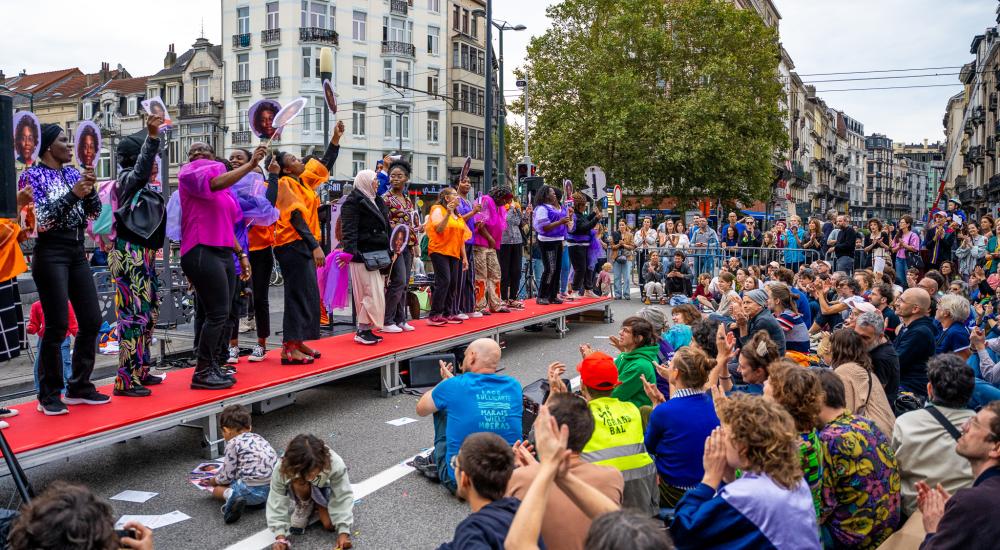
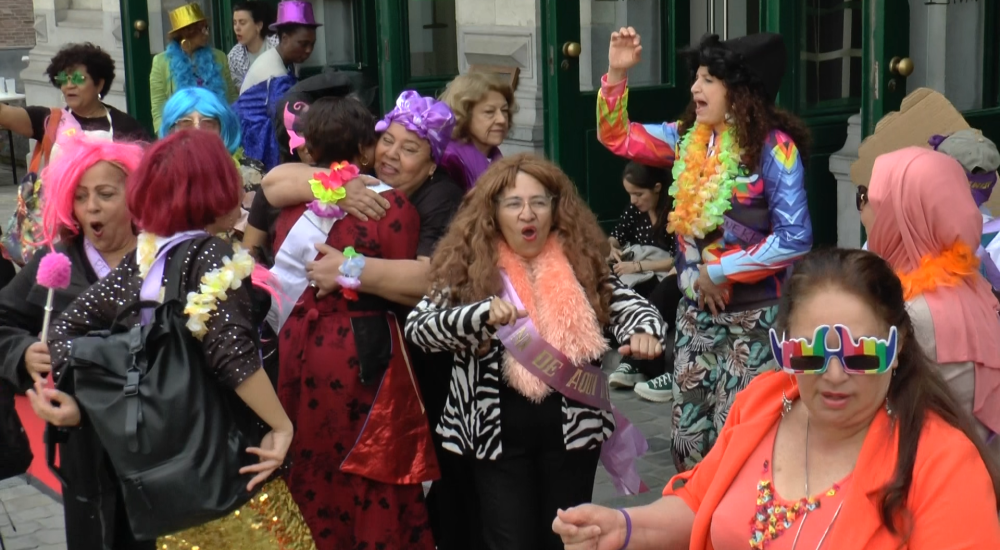
The first glimmer of this work could already be recognized in A Life Worth Living, a four-day workshop held at the Free School of the Kunstenfestivaldesarts, which revolved around the question: “Qui prend soin de celles qui se prennent soin?”—Who takes care of those who take care? The workshop brought together multiple voices, such as Territorio Domestico, la Ligue des travailleuses avec et sans papiers/CSC Bruxelles, and seminal feminist scholars and activists as Silvia Federici, Maddalena Fragnito and Lea Melandri, in an encounter that opened up and shared a toolbox of women from diverse professional, migratory, and generational backgrounds. It culminated in a subversive catwalk, where the characters born from the workshop – humorous, flamboyant embodiments of women’s struggles and resilience — left the domestic sphere to take over public space, carrying all their creative and conflictual power into the festival.
That moment became a prelude to a new, joyful eruption into public space. In September 2024, as the local elections approached, the collective face of a fictional Candidate Sans-Papiers appeared across the city — hundreds of posters reclaiming the streets and making visible the lives of migrant people, precisely when the machinery of elections tends to erase them from public debate.With a passerelle very different from those of political campaigns, held on the Pont des Flandres during MolenFest, les candidates together reclaimed the agency to affirm how local institutions should truly function: placing the construction of the common at their core. And this goal might be achieved by acknowledging the experience and intelligence of those who know the value of care, accessibility, and justice, and who recognize the reparative potential of anti-colonial feminist alliances. This is how the Candidate was born: a subject whose political power lay not in the possibility of being voted for, but in becoming a tool of recognition for a small group of women who continue to perform her speeches in different public contexts, finding in this fictional persona an instrument of self-representation and proud identification.
As our lives and struggles for daily survival became ever more intertwined, helping each other securing housing, supporting public appearances, and granting ourselves moments of self-celebration, we soon found ourselves relaunching our trajectory on a broader platform, one commensurate with the scale of European immigration politics. In May 2025, once again with the support of Kaaitheater and Kanal Pompidou, a constellation of individuals, groups, collectives, and unions from Brussels,Spain, Italy, and France, gathered for two days of intense discussions, shared meals, and singing. These encounters culminated in the main square of Molenbeek with a public ritual that sealed a transborder anti-racist alliance of immigrant feminists.
It was not a “symbolic gesture”, nor the naive belief that naming something makes it exist. Rather, this public action sought to mobilize energies to move from the realm of imagination to that of practice, to enact the urgent need to build a unified, though heterogeneous, front against the European Migration Pact. In the heart of a rearming Europe — one that finds its unity through the figure of an external enemy, and tightens borders in the name of protecting “our” women — it is a front of women from across the world, grounded in diverse European contexts, that puts sisterhood and care at the very core of political debate.
Today, the FORTES alliance (Feminists, Organized, Resistant, Transborder, Exiled and in Sisterhood) exists. It exists because there is a shared agenda, a calendar of joint actions, and a mutual desire for connection, to remain present in each other’s lives and struggles, less isolated amid the harshness of these times.
What’s Next in Our Temporality?
In Brussels, we are now preparing for a new workshop, to be held in October once again in Kaaitheater, with the desire to keep working on the question of temporality, to exercise, consciously and affirmatively, a form of agency over time. While the present often feels like the stagnant pool of a permanent emergency, a loop that endlessly resets to zero any effort to survive, we are trying to bend time to our use. Or rather, to stretch it, to lengthen it, to stress it, as we experiment with generosity and abundance.
At the same time, we are trying to anchor it by creating points of attachment in personal and collective memories, building an initial attempt at an archive of the struggles of sans-papiers women in Belgium. The strategy is to reclaim a genealogy of resistant women: to experience what it means to belong to a long lineage of struggle, to draw inspiration from those who came before, and to transmit both responsibility and pride to those who will come after. Our ambition is to fight the exhaustion of being the first, the fear of being the only one, by reclaiming a material memory made of objects, names, and stories to hold onto, in order to rediscover the strength of those who have already faced many crises with intelligence and generosity. And to recognize those women among our sisters in the same room.
Co-design, Or “what is it? when we say we are in it together”
One of the main challenges of this kind of artistic creation lies precisely in the continuous redefinition of the boundaries of the we. Is it enough to be in the same room to recognize ourselves as a collective we? What does co-design mean when there are such marked differences of privilege among the people involved in the artistic process? How can practice help us continue to challenge the very notion of authorship? These are the questions we grapple with as dramaturgs, accomplices and first concerned. What are the needs that hold us together, even as we remain aware of our differences? What are the desires that shape our practices?
The first attempt toward this new we stems from Anna’s own desire for alliance: on the one hand, from her questioning of her privilege as an artist within postcolonial Europe — the Europe of borders and the supremacy of whiteness — and on the other, from her wish to see what might truly happen by bringing into contact two collectives of women engaged in the same struggle for regularization and racial justice in different contexts. What could their alliance produce? How could tools be shared? At first, Anna began working with already-formed collectives, recognizing the political intelligence already active on the field, their own knowledge and practices. Today, we see that the collective we are dealing with is constantly doing and undoing its own body through shared practice. Co-design, therefore, cannot be reduced to a mere division of tasks; it comes to life through the expression of desire, when someone dares to name a direction, and when another takes on the care and responsibility of making a part of it real.
We find ourselves facing an osmotic subject that takes shape through doing: sometimes it is a small core; other times, an assembly; and still others, a temporary community formed around the occupation of a public space, when even the audience takes part in ensuring the safety of performers who challenge their condition of administrative irregularity by making themselves visible.
Yet it is important to emphasize again and again that this experience of alliance is constrained by the impossibility of travel for almost all those involved, due to the European legal framework and national regulations that endanger these women, not only when traveling abroad, but even when moving across the city.
And yet, across all these differences, a “we” persists. We have recognized it in those moments when we have felt a sense of belonging: “La candidate, c’est nous!” The truth is that the institutional frameworks in which projects are conceived, produced, and funded still refer to a notion of authorship that is far narrower than what is constantly negotiated within these practices.
A Breach for the Unexpected
In fact, this is what artistic practice does: it opens space for what does not yet exist. It works by smudging the boundaries of what we already know, what already functions, what already seems possible. And even within this group of women marked by many differences—with asymmetries that can at times manifest in violent ways, where some possess a strong capacity to order their experiences and share them persuasively, while others struggle even to recognize their own thoughts as legitimate, the body intervenes and can subvert this equilibrium.
Artistic language, then, makes it possible to expand each person’s space for action, to uncover resources that were previously out of reach, to step into discourse as a protagonist with one’s own capacity to act. In this sense, artistic language activates discourse itself, opening a breach for the unexpected, unfolding conversations in formats that democratize access, for those who wish to speak and those who need to listen.
The challenge is to take responsibility for sharing the material and social capital that the artist holds, while no longer taking for granted that the group involved is homogeneous in its conditions of need. But this is only a good starting point for an exercise in the decolonization of practices, one that demands an ongoing negotiation of presence and distance: knowing when to step forward to take responsibility, and when to step back to support self-organization.
How do we build a safe space where friction becomes an opportunity for listening and growth, and conflict a possibility for meeting each other more justly? Or, as in some of the debates we have already faced: how can we build a circle in which we recognize ourselves in something broader than a feminism that still acts as a colonial instrument of oppression? How can we see ourselves as women resisting the same oppression while living in radically different conditions? All this, while some among us have spent the past years questioning the very word women, wondering whether it is still a container wide enough to hold all the possibilities for new alliances.
And perhaps this is where we began to feel the possibility of a we: not when we found the same answer, but when we belonged to the same open conversation, with much still left to say.