Part of ENCORE
Full program
Mira Thompson Carly Everaert
On access intimacy and On pain worth sharing
Two video-essays
Mira Thompson is an advocate for disability justice, singer, performer, artist and teacher-researcher. Carly Everaert is a costume designer, curator, artist and teacher-researcher. Their collaboration began within Everaert’s Radical Thinking course at the Scenography department of the Academy of Theatre and Dance in Amsterdam. Sharing a deep interest in intersectional theory, embodied knowledge and accessible artistic practices, they explore how disability justice can be both a theoretical framework and a practical method for reshaping art education and production.
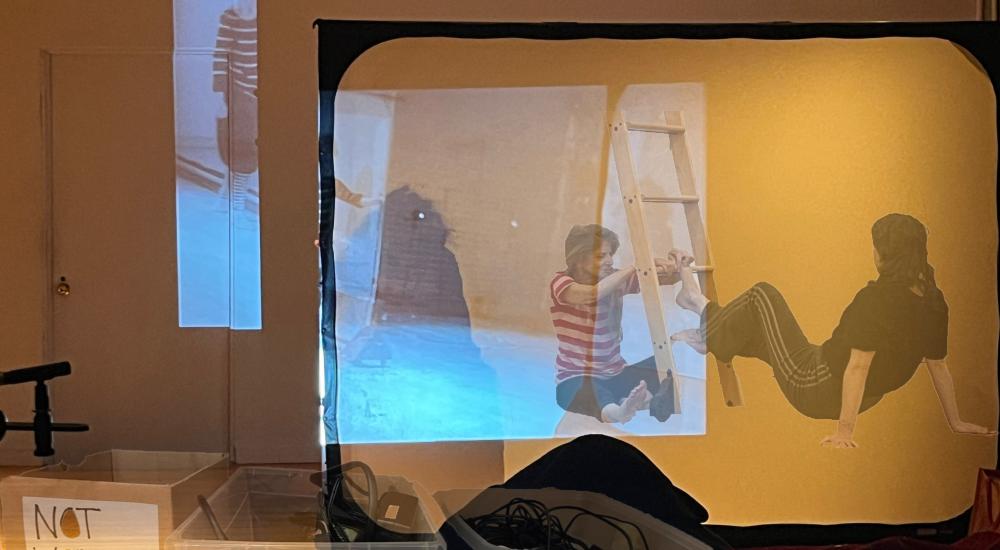
ENCORE features two open-source video lessons from their project:
On access intimacy
Video with sound, 13:19 minutes
English with Dutch subtitles and descriptive transcript (text-based document PDF including audio and image descriptions)
This first video-lesson departs from the concept of “access intimacy” as coined by the American-Korean disability justice thinker and writer Mia Mingus: “... that elusive, hard to describe feeling when someone else 'gets' your access needs. The kind of eerie comfort that your disabled self feels with someone on a purely access level.” The video is a teaching tool, designed for teachers or other (self-) educators and learners who are interested in the way bodies are historically (under) represented, and invested in creating more awareness of the social, political and philosophical definitions of disability.
On pain worth sharing
English with English or Dutch subtitles, 28:19 minutes
The second video-lesson departs from a central argument in “Pain Worth Sharing,” an essay written by Mary Grace Bernard, an artist and scholar living with cystic fibrosis, a chronic illness that informs her daily art and writing practice. In the essay, Bernard explores the work of Bob Flanagan and Johanna Hedva: ”…while each artist reveals their body as personal and political, I concentrate on Flanagan’s way of exhibiting the self and Hedva’s emphasis on displaying the political to show how each artist breaks down the binary that divides public and private space, art and life, performer and viewer, and body and mind.”
These video lessons invite reflection, dialogue and embodied engagement.
The films last a total of 41 minutes and 38 seconds. We will take a break of approximately 20 minutes. The films will be shown on a loop, starting on the hour from 11 a.m. to 4 p.m.
Mira Thompson (Amsterdam, 1993) is a singer, songwriter and performer. Informed by the tradition of vocal jazz, she is drawn to narrative song and strong poetic and visual elements within music. During her time at HKU Utrecht Conservatory, she developed a fascination for the different ways in which the voice can function as an embodied instrument. Whether written, spoken or sung, Mira wields language to evoke deep and buried feelings with an earnest yet witty approach. In 2019 she released her first EP Festina Lente. Since 2008 she has performed nationally at Mozaïek Theater, Frascati, Casco Art Institute: Working for the Commons, among others, and has toured in Germany and France.
Carly Everaert (1960) is a thinker and costume scenographer. Since 2009, they have been teaching at the Scenography department of the Academy of Theatre and Dance in Amsterdam, combining artistic research and education. Everaert explores themes such as sustainability, embodied knowledge, and intersectionality, often in collaboration with other makers and researchers. In 2022, they received the Proscenium Prize for their entire body of work. Both within and beyond the theatre, Everaert develops installations, costumes, and educational materials that invite critical reflection and collective imagination.
Tickets

Good to know
The films last a total of 41 minutes and 38 seconds. We will take a break of approximately 20 minutes. The films will be shown on a loop, starting on the hour from 11 a.m. to 4 p.m.