Antifascism, with Obstacles
Toward an Everyday Practice
After the two editions of the study days of Figures of Fascism and Antifascist Solidarities, programmer and dramaturg Bojana Cvejić writes her reflections on antifascism and antifascist political organizing today. You can find the full programme here (first edition) and here. (second edition)
The discussions with Valeria Graziano and Tomislav Medak on Pirate Care can be seen here. The keynote lectures by Brenna Bhandar and Alberto Toscano from the first edition can be seen here. The conversation between Bojana Cvejić and Sarah Schulman is available here.
Antifascism, with Obstacles
Toward an Everyday Practice
by Bojana Cvejić
What is antifascism today, what is antifascist political organizing? Asking the question in a straightforward way, in the indicative, realis, rather than in the modal, irrealis mood –what could antifascism be today – implies a certainty, without hedging on possibility or just wishing things that are not. Yet to arrive to a limited and specific set of answers with examples, we might have to walk around political obstacles and historical conditions, engaging with each one of them carefully so that the proposed orientation for antifascism, with its referent practices, get the flesh and the ground it merits for political credibility.
As a dramaturg, living in Brussels with a Yugoslav non-aligned socialist heritage, I have been attending to what forms of collaboration and collectivity arise when we make performances or when we self-organize artist-run spaces based on commoning time, space, goods, skills and concerns. With a hat of researcher and professor, I’ve been recently trying to redirect institutional attention and funds toward projects and collectives that build solidarity with those who are affected by today’s democratic fascism. This text builds on my research on the exchanges of, and the gaps between working methods of artistic practices conceived in a nonfascism spirit and those of policial struggles that identify more explicitly as antifascist.
For another timeline
Such inquiry builds on the fact that the characterization of our present as fascist is no longer as contested in political theory and journalism as it was until recently. Alberto Toscano's Late Fascism has gifted several prominent voices a political conceptualization to work with. (1.) Instead of treating fascism as a political ideology that congealed in the 1930s under its classical guise and now seems to ‘return,’ the thesis of ‘late fascism’ suggests that we would do better to approach it as a longue-durée process of fascization — embedded in colonial modernity and experienced differentially ever since, throughout twentieth-century liberal capitalism and into the present.The evidence for this lies in the perspectives of decolonial Caribbean thinkers, like Aimé Césaire or George Padmore (2.), and in the Black Radical Tradition, like Cedric Robinson (3.), Angela Davis or the Black Panthers, where the experience of colonial or state terror through segregation, mass incarceration, and the killing of racialized people was nothing short of fascist. Fascism continues within liberal democracy, as the same oppressed people have called for antifascism to fight the extreme realities of racialization such as genocide and apartheid – but also ethno-nationalism, oligarchy and state violence – 1951 (4.), 1969 (5.), 1977-80 (6.), 1995-2025 (7.) in the U.S., South Africa, Turkey, former Yugoslavia etc. Today's warnings of fascism as a threat of a future event reveal a liberal political reflex that ignores the “ongoingness” of an “uneven” fascism — “combined” and coexisting, always differentially, with other political rationalities (Daniel Loick (8.)) across different geopolitical contexts, communities, and constituencies. Breaking with the temporal predicament between ‘never-again’ and the coming “end-times,” (9.) some cultural critics advocate a postapocalyptic environmentalist timeline of the present, which, when overlaid onto this enduring fascism, means that catastrophe for some — those who are affected the most — becomes necessary for the normality of others, who now also begin to feel their own lives diminish under the illiberal authoritarian drift.’ (10.)
Antifascism faces similar problems regarding its temporality. Conspicuously, it becomes the object of political history rather than contemporary political theory — a shift visible in the academic literature (Joseph Fronczak (11.)) and in popular activist writing (Jonas Bals (12.)), both of which offer a longue-durée history of the left with a focus on culturally and ideologically diverse, protracted liberation struggles. Bals’s small regional stories from Norway, crisscrossed with other, more famous parables from a transnational antifascist inventory, lay the groundwork for antifascism today as a broad coalition of antiracism, anti-imperialism, anti-authoritarianism, transfeminism, and democratic socialism. The strength of such a diversely poised political and cultural platform is at once its potential weakness: its rejection (but also impossibility) of a strong ideological unity in favor of a broad coalition of oppressions may mean a slower pace, and a more diluted, less radical, sense of opposition. Especially, when compared with the fiery outcry of antifascism in two moments, “Hands Off Ethiopia” international uprising in 1932 and Dolores Ibarruri’s “fascism we shall not let pass.”
The comparison highlights a significant difference between the antifascism that grew out of the international brigades during the Ethiopian aggression and the Spanish Civil War in the 1930s, and our difficult contemporary moment. However large and divergent the antifascist popular front in Europe was — bringing together communists, anarchists, social democrats, and liberals on a transnational basis — it preserved a revolutionary spirit at its edges, with socialism woven into it as a real political alternative to capitalism. Having grown up in socialist Yugoslavia, which constituted itself after WWII on the legacy of antifascist communist and partison resistance, and where we pioneers raised our fists to shout “Death to fascism, freedom to the people,” I am now watching Serbia live its own mafiocratic variation of authoritarianism supported by Europe. And I share, for that part, the sense of political defeat of leftist thinkers like Enzo Traverso or Daša Drndić, who call out Europe for its betrayal of the historical commitment to antifascism on which European democracies were built. Postwar European democracy, born from the victory over fascism, undergoes an ideological reversal during the Cold War. Perhaps the betrayal has been programmed within democracy all along. Rather than confronting fascism, which persists through the right’s continued alliance with its extreme wing, democracy turns its energies against the socialist and communist left. Historical revisionism ensues from the post 1990s campaign to produce an equivalence between Hitler’s and Mussolini’s fascism and the East-bloc, especially Stalinist socialism. In the name of human rights, several resolutions have declared “measures to dismantle the heritage of former communist totalitarian systems.” (13.) Despite critics who note that equating extermination camps with gulags and other crimes of communism has served to discredit communism and socialism wholesale, the political campaign led by former Eastern Bloc states in Europe has succeeded in marginalizing the antifascist legacy of partisans, communists, and socialists worldwide. Europe’s current electoral politics make the pattern visible: centrist liberal parties claim no alliance with the far-right parties now winning elections, all while moving closer to their ultranationalist and xenophobic programs. Yet these same centrist parties are far more keen to build a firewall against the leftist workers’ parties instead.
From the social inventory of antifascism to a nonfascism in our bodies
In addition to anticommunist disavowals of antifascist legacy, antifascism today faces two more obstacles. One is the contempt and mistrust garnered around “antifa,” where the label stands for a motley of local militant groups who confront right-wing militias in counter-violent defense of the people attacked by these ultraright groups. Among many oppressed and discriminated people in the ghettos across European are people who are thankful to Antifa’s actions to clear streets from Neo-Nazis and racist thugs for their survival. Echoing the condemnation of communism as a form of state terror, U.S., with a few European countries to immediately follow, has proclaimed Antifa, together with Anarchists and “Violent Left-Wing Extremists,” as one of the terror groups it will “neutralize” and “cripple operationally” (United States Counterterrorism Strategy, May 2026) (14.). This conflation of antifascism with terrorism marks the crackdown on any political dissent against the authoritarian increasingly punitive governments. It also extends to groups like Palestine Action who use direct action against arms trade with Israel in a call to divest from a genocidal war.
The second, and last, obstacle I will discuss in more detail before turning to the question of what antifascism entails nowadays is less straightforward and more difficult to track, as it concerns a cultural process – a transformation of attitude among artists and intellectuals of the cultural left since the 1970s that still prevails today. I’ve referred to this attitude as nonfascism (15.). Its main feature is a nonviolence born from an aesthetic and libidinal reckoning with what the anti-authoritarian, youth-spirited counterculture of the 1960s understood to be the fascist body: a rigid, obedient, and invincible body subordinated to the disciplinary hierarchies of various institutions — family, state, prison, mental asylum or military. Out of nonviolence as a pledge of nonfascism directed to these institutions, many reforms as well as more radical alternative approaches to psychiatry and pedagogy followed, including abolitionism of prisons and other forms of carcerality (not least the heteronormative family institution). This is poignantly summarized in the turning point of Black Panther Party known as Revolutionary People’s Constitutional Convention “Survival Through Service to the People” in 1970. Militancy would be re-directed to self-organizing the reproduction of social life within the community, including healthcare and schools. The ten-point program of BPP famously included the transport for relatives and parents of prisoners, in order to, I am quoting Huey Newton here, “expose the fascist regime that operates the prisons throughout America doing their treachery in the dark.” Black Panthers then proclaimed that antifascism will have to shift terrain from armed struggle to social reproduction (the social life outside work: in schools, hospitals, ghettos and infrastructures of the living)– to make sure that people can preserve themselves in collectivity – because they knew that fighting fascism will be a long process from the perspective of black life. From the 1970s on, we can thus speak of a kind of inventory of multiple reforms across oppressed as well as politically active groups that oppose fascism through. A very small part of that inventory are also elements of dance experimentation in the same period of the 1970s, specifically those which sprang from the antiwar movement and U.S. anarcho-liberal counterculture, like Contact Improvisation. Rejecting the disciplinary training of dance technique, the post-modern dance experimented with gravity, release from geometrical vertical alignment, deep listening to inner sensations, and physical and social encounters with other bodies on equal terms. Among several other dance forms, Contact Improvisation explicitly encapsulates the anti-war ethos of these experimental postures, as in the words of its co-founder Steve Paxton who explains how Aikido’s principles of deflecting an opponent’s attack was crucial for this form:
“It was a profound shift from dancing to go into aikido movement and suddenly not have art be the reason you were moving the way you were, but you were moving the way you were for survival … You were responding with harmony to the violent – unbelievable!”
If you don’t take a “self-inflicted position relative to aggression,” and don’t “wimp out” in a fight, you are not an easy target: “it’s much more complex for people to attack you because you’re not presenting yourself as a victim.” When I asked him whether contacters could be regarded as a special kind of warriors, Paxton denied it: despite training dancers in martial arts, perceptual challenges, orientation, and strength, “the point of it was that they aren’t warriors.” Dancers must be de-trained, he said, to become just “masses, bones, nerves and sensations,” as physical events alone (16.). And in this neutralization and reduction to the physical form lies the limit of the nonfascist nonviolent body: as Trajal Harrell has shown, this body failed to encounter Black and Latinx vogue balls of Harlem of their time – precisely those bodies that have experienced fascism differently from the predominantly white dancers at Judson Dance Theater. At the same time, non-violence understood as resistance to gravity, fearlessness in contact, giving and receiving weight, and fluid alignment are all features that match the nonfascist imperatives of libidinal politics in the 1970s. Michel Foucault spearheaded nonfascism on these very terms when he said: “We must invent with the body, with its elements, surfaces, volumes, and thicknesses, a non-disciplinary eroticism: that of a body in a volatile and diffused state, with its chance encounters and unplanned pleasures.” Foucault’s call for a demilitarisation through aesthetically and erotically reinventing oneself still resonates with cultural theorists of fascism, like Klaus Theweleit, who since the 1980s argues explicit for nonfascism (as opposed to antifascist militancy) as a struggle against “social and political fears [that] have become bodily states.” (17.)
Theweleit’s thought is still with us – in the cultural sphere – when he observes fascism as a fear of losing one’s bodily integrity, of disconnected body, flooding, and unboundedness and the self-armoring to protect it, particularly among cisheteromen. A nonfascist orientation, following Theweleit’s analysis of fascist embodiment, would involve recognising interdependence rather than pursuing social atomisation and hyperindividualism; accepting contradiction, uncertainty, and alterity rather than seeking purity and closure; and constructing forms of collectivity that remain open to the “others” who destabilise homogeneous identities.
This kind of cautious corporeal approach that we find in Theweleit matches more recent musings on fascism. It is similar to what the activist journalist Natasha Lennard attends to when she asks: How does one keep from being fascist, even (especially) when one believes oneself to be a revolutionary militant? (18.)The question points to the Deleuzo-Guattarian notion of microfascism as the investment of desire in hierarchy, purity, domination, and exclusion – forces that can emerge among individuals in any community. Foucault warned about it in his praise of Anti-Oedipus as a book on ethics of nonfascism: “The major enemy is fascism in us all, in our heads and in our everyday behaviour, the fascism that causes us to love power, to desire the very thing that dominates and exploits us.” (19.)
If nonfascism has fuelled progressive practices in arts and culture since the 1970s, why can’t it any longer oppose fascization? I would like to underline only one in many answers to this difficult question, which stems from the moral purism of nonfascism. Nonfascism often redirects individuals toward themselves rather than toward forging kinship with those unlike them. Consequently, I have witnessed communities in classrooms, dance studios, and artist-run socially ‘safer’ spaces unravel under a combination of self-righteousness, guilt, and policing that ultimately reinforces individual moral standing rather than advancing the common cause. Preoccupied with interrogating one’s own microfascist propensities, and too careful of not stepping out of their own identitarian boundaries, individuals miss the opportunity to engage in a struggle with those who are most affected by fascism. Engaging in a struggle despite recognizing disparities in positionality requires taking a step from an ethical into a political sphere in which one organizes one’s conduct and action in defense of a political demand or principle against fascism.
Practicing antifascism everyday
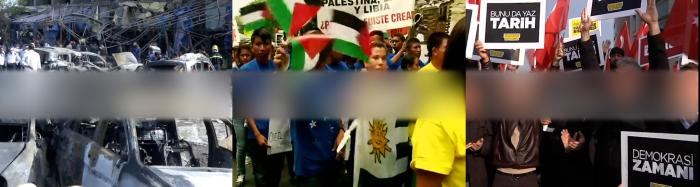
At the time of writing this essay, thousands have taken to streets in Madrid in a movement for housing justice, against evictions and the real-estate “vultures” — “Gorriones de barrio contra el buitre inmobiliario,” as a sign at the protests read — who have made living in the Spanish capital, not so different from other European cities, unaffordable for anyone but the wealthy. These protesters immediately identify their demands as antifascist. Chanting antifascist songs and slogans from the Spanish civil war, they vie for the Third Republic and wave its flag. As they chase out Vito Quiles, a prominent far-right influencer, they plaster stickers on walls, tents, lamp posts, around their tent encampments, signaling their intent to force out of their neighborhoods racists, machists, homophobes, transphobes and real-estate vultures alike. (20.) The images in which they rename streets (“Calle de Maricarmen” (21.)) are so irresistibly similar to the scenes in which undocumented people and their allies in Brussels renamed streets in the Belgian capital with the name of Semira Adamu, the woman who died from a brutal police operation to forcibly deport her — an echo of the broader campaign to strip Léopold II's name, the butcher-colonial king, from Brussels’ streets. (22.)
At the same time, thousands of students across the world, not only in Western Europe, but in Serbia and India, too – with their teachers, parents or, more generally, an older generations concerned about their future – have taken to the streets to call for their right-wing governments to re-invest in education as a public good for everyone. In many cases of long-term protests, as in Serbia, for example, the demands of students grow to encompass a more systemic political change, against disparity between the ultra-rich and the impoverished middle and lower classes, and for a democracy based on social justice.
Two distinct modes of upheaval have marked the last three decades: long-lasting protests that follow a nonviolent, democratic script, and riots, shorter and more dramatic irruptions in which a constituency revolts because its repression has been aggravated by police, administrative, or capitalist brutality, or, at times, because unknown actors in black masks, young hooligans, or police agents provocateurs hijack the protest for a fight (23.). Together, they have staged in public an array of intersecting issues, and have manifested the bodies of those who are targeted and scapegoated by fascism. Immiseration is the common background to most of these protests, forming the basis of a widespread feeling of social injustice. But the fronts of struggle extend further, amounting to a long list that points to the far-right agenda of many governments: anti-immigration, anti-abortion, and anti-disability laws and moods; femicide and other gender-related crimes; denial of the climate disaster; racism; corruption and abuse of state power; disinvestment in education and the arts; and the criminalization of solidarity with Palestine, to mention the most rallying ones. As brutalization led by governments and their corporate partners intensifies, the variety of causes above begin to meet under the same banner of antifascism. Antifascism thereby acquires a broader meaning today: a diversified field of opposition and contestation against measures – manifestly legal, but substantially politico-ideological – that are increasingly understood as the contemporary, democratic form of fascism.
Apart from the large street manifestations of antifascist revolt, everyday struggles against contemporary fascism continue in molecular units dedicated to the same causes but operating through self-organized action — collectively run projects, online platforms, spaces and occupations that persist continuously, if on a smaller scale. The truth is that there are myriad such units, probably as many as, if not more than, extreme-right militias, and they are widespread across the planet. The occasions on which they manage to forge an alliance — as, for example, in the projects of migrant women care workers fighting for regularization, La Candidate (Brussels) and Territorio Doméstico (Madrid), or in the large transnational network of Pirate Care — are moments in which we can glimpse the potential of an antifascist common front.
What makes them decisively antifascist, in distinction from a more prevalent attitude of nonfascism? What remains from the nonfascist attitude is an acceptance of the fluidity and permeability of boundaries between diverse constituencies — that ‘being many’ involves both alliances and the interweaving of singular differences, where, to paraphrase the novelist, playwright and queer activist Sarah Schulman, one must cede to another’s style of action, even if it doesn’t suit your own, if you are to share the same struggle (24.). To sharpen these distinctions, I’ve worked to distil four arguments.
First, solidarity as a motor of collectivity, where “nobody shall be left alone” (25.) in crisis, must entail seeking alliances with those who are concerned in the first place, and who might be dissimilar to you; who share the condition and/or political conviction to defend against a fascist measure or assault. Solidarity among unequals means that not only the work, time and the political rhetoric of the struggle, but also the risks must be redistributed. Taking collective responsibility for a situation comes with a cost and often negative consequences. Solidarity in time of its criminalization has meant that the privileged allies sacrifice and lose something they invested in the struggle with their social, symbolic or material capital. Sometimes, it may go as far as losing job, friends, family, or influence. The work entails invention and sometimes also breaking rules while organizing, but a large part of it also requires accepting discomfort, slow and messy collectivity and then stamina in accepting violence of those afflicted redirected onto the ally, the person who joins the struggle on the basis of political commitment.
Second, participating in multitudinous coalitions and heterogeneous forms of action and political organizing includes tactical alliances, especially if pragmatism, for the sake of upping the scale of a movement and its “winnable goals” (Schulman), means accepting various motifs and attachments, including ones other than purely political, that people might have when they join an antifascist struggle. To safeguard against compromises that dilute commitment to the root cause of a struggle, there must be collective agreement on non-negotiable lines — lines whose crossing necessitates collective refusal.
Third, leftist organizations tend toward atomization, splintering into ever more radical factions. While sharpening the ways of belonging to a collective with one’s comrades, how does one engage with the middle — often the largest part of those who remain indifferent or passive — and with one’s potential adversary? Is it important to step outside one’s ingroup, against its tendency toward separation from the mainstream, and engage in speaking with, or even persuading, the undecided middle? (26.) In recent years, we have seen droves of young people engage in door-to-door campaigns to help the left win in the UK, Germany, Serbia, and France. The success of the current student movement in Serbia owes largely to its tireless, sprawling marches through villages across the country, speaking to the poorest, least educated strata of the population, and winning the hearts and minds of those who otherwise regard them with anti-intellectual contempt. In another example, speaking with the transgender Marxist theorist Bini Adamczak (27.), who took part in a door-to-door campaign for Die Linke (the German Left Party), I understood that the encounters on the doorstep could be twice as uncomfortable for her, as a leftist and a trans woman.
Fourth, younger generations of students, especially artists, often say that the threshold for joining antifascist action or social practice seems too high: it demands a lot of their time; it requires being prepared for conflict and facing violence; and the work seems vast, endless, and without reward. To these doubts, I have heard Tomislav Medak and Valeria Graziano (28.) respond that it doesn't take much to start from somewhere, on a small scale – to tinker, recognize collective needs, and figure out the collective action needed to meet them. Something collective will get transformed along the way. Shifting focus from solely one’s own work to co-creating a context and a situation in which more people can act, share a common struggle, and eventually live more dignified lives by building on interdependencies, might be the first step. To the same doubts, I've responded by saying that activism isn’t a profession; the day has 24 hours, and we need to practice being generous with our time. For instance, how might we turn the multitasking of freelance work from productivist ends toward more holistic and social purposes? There is always enough time for individual as well as collective work, because it might well be that collective practice and political organizing is what makes all other individual’s endeavors possible.
***
This text has brought two sets of questions together: What are the historical and political obstacles and conditions that force us to reconceptualize antifascism today in the face of contemporary fascism? And what might distinguish antifascist action and social practice from a nonfascist life? These questions made me shift register, moving from historical and political analysis and commentary — including the parable of a nonfascist blueprint in the 1970s dancing body — to a discussion of current examples and problems in antifascist political organizing. Perhaps, as a sign of our times, the only way this piece can end is by drafting four points — less a program than a handful of principles for sifting through the concrete prospects and obstacles of antifascism.
(1.) Alberto Toscano, Late Fascism: Race, Capitalism, and the Politics of Crisis (London: Verso, 2023). See Norman Ajari, Technofascisme: Le nouveau rêve de la suprématie blanche (Paris: Météores, 2026) and Alexander Aerts, “Too Late Fascism: A Review of Alberto Toscano’s Late Fascism,” Krisis: Journal for Contemporary Philosophy 44, no. 2 (2024): 43–47, https://doi.org/10.21827/krisis.44.2.41338.
(2.) Aimé Césaire, Discourse on Colonialism, trans. Joan Pinkham (New York: Monthly Review Press, 2000). George Padmore, “Hitler, Mussolini and Africa,: The Crisis 44, no. 9 (September 1937): 262-263.
(3.) Cedric J. Robinson, “Fascism and the Response of Black Radical Theorists,” in Cedric J. Robinson: On Racial Capitalism, Black Internationalism, and Cultures of Resistance, ed. H. L. T. Quan, foreword by Ruth Wilson Gilmore (London: Pluto Press, 2019), 149-59.
(4.) Civil Right Congress, "We Charge Genocide," in The US Antifascism Reader, ed. Bill V. Mullen and Christopher Vials (London: Verso, 2020), 202-217.
(5.) The United Front Against Fascism (UFAF) was an antifascist conference organized by the Black Panther Party, held at the Oakland Auditorium in Oakland, California, from July 18 to 20/21, 1969, pitched as a call by Bobby Seale broader than the BPP. See "United Front Against Fascism," Fifth Estate, no. 83 (July 10–23, 1969).
(6.) Devrimci Yol ("Revolutionary Path," DEV-YOL) was a self-organized leftist group that appeared in the context of Turkey's late-1970s political violence, which pitted the revolutionary left against far-right ultranationalist groups (notably the Grey Wolves) and state security forces, escalating into political unrest that was then used to justify the 1980 Turkish military coup.
(7.) Rastko Močnik, Koliko fašizma? (Ljubljana: Zbirka Krt, 1995). Zajednička čitaonica #6: anti/fašizam, Daša Drndić and Andrej Nikolaidis (Beograd: Udruženje KROKODIL, 2020). Rade Veljanovski, ed., Fašizam i antifašizam od nastanka do danas: uzroci, pojavni oblici, posledice: zbornik radova (Beograd: Savez antifašista Srbije, 2026).
(8.) Daniel Loick, "Uneven and Combined Fascism: A Postapocalyptic Perspective," Emancipations: A Journal of Critical Social Analysis, 2025, available at https://scholarsjunction.msstate.edu/emancipations, DOI: 10.55533/2765-8414.1197
(9.) Naomi Klein and Astra Taylor, End Times Fascism: And the Fight for the Living World (New York: Farrar, Straus and Giroux, 2026).
(10.) See Evan Calder Williams, “On Paralysis, Part 1,” e-flux Journal. 2023. Online: https://www.e-flux.com/journal/141/579867/on-paralysis-part-1 quoted in Loïck, “Uneven and Combined,” 1, manuscript
(11.) Joseph Fronczak, The Five Ages of Antifascism (Cambridge: Cambridge University Press, 2026).
(12.) Jonas Bals, Sammen bekjemper vi fascismen: strategier for antifascister i dag (Oslo: Res Publica, 2025).
(13.) Parliamentary Assembly of the Council of Europe, “Measures to Dismantle the Heritage of Former Communist Totalitarian Systems,” Resolution 1096, adopted June 27, 1996, https://pace.coe.int/en/files/16507/html; Parliamentary Assembly of the Council of Europe, “Need for International Condemnation of Crimes of Totalitarian Communist Regimes,” Resolution 1481, adopted January 25, 2006, http://assembly.coe.int/Mainf.asp?link=/Documents/AdoptedText/ta06/Eres1481.htm; “Prague Declaration on European Conscience and Communism,” Prague, June 3, 2008, https://www.memoryandconscience.eu/prague-declaration/.
(14.) The White House, United States Counterterrorism Strategy, May 2026, https://www.whitehouse.gov/wp-content/uploads/2026/05/2026-USCT-Strategy-1.pdf.
(15.) Bojana Cvejić, “Van het non-fascistische lichaam tot antifascistische allianties,” Etcetera, no. 183 (September–December 2026): 66–75. The English version from which some of the arguments further in the text can be retraced is available online: https://e-tcetera.be/when-bodies-move-against-fascism/
(16.) Steve Paxton quoted from Bojana Cvejić and Lennard Laberenz, ...in a non-wimpy way..., video, 2013, https://vimeo.com/76095626.
(17.) Klaus Theweleit, Male Fantasies, Vol. 1: Women, Floods, Bodies, History, trans. Stephen Conway, Erica Carter, and Chris Turner (Minneapolis: University of Minnesota Press, 1987) and Klaus Theweleit, La possibilité d’une vie non fasciste : Chroniques d’une Allemagne hantée, trans. Christophe Lucchese, ed. Déborah V. Brosteaux and Christophe Lucchese (Bruxelles: Météores, 2024).
(18.) Natasha Lennard, Being Numerous: Essays on Non-Fascist Life (London: Verso, 2019), 2.
(19.) Foucault, “Preface to Anti-Oedipus,” in Gilles Deleuze and Félix Guattari, Anti-Oedipus: Capitalism and Schizophrenia, trans. Robert Hurley, Mark Seem, and Helen R. Lane (Minneapolis: University of Minnesota Press, 1983), xiii.
(20.) For a beautiful selection of stickers and posters see John Collins, “The Art of Resistance: Scenes from the Madrid Encampment.” Weave News, October 1, 2026. https://www.weavenews.org/stories/2026/10/1/the-art-of-resistance-scene…
(21.) The street was named after Maricarmen Abascal, an 87 year old woman whose eviction from her home, where she lived for 70 years, on a stretcher caused immediately protests around the perennial housing crisis in Madrid.
(22.) See Nizar Saleh Mohammed Ali, dir., Tout contact laisse une trace, produced by ZIN TV (Brussels, 2024), 67 min.
(23.) See Joshua Clover, Riot. Strike. Riot: The New Era of Uprisings (London: Verso, 2016).
(24.) Sarah Schulman in conversation with Bojana Cvejić, “The Fantasy and Necessity of Solidarity” (Figures of Fascism and Antifascist Solidarities, Kaaitheater and P.A.R.T.S., Brussels, September 19, 2026), https://kaaitheater.be/en/agenda/26-27/fantasy-and-necessity-solidarity
(25.) See Bojana Cvejić, “Solidarity as a Common Notion: The Transindividual ‘We’ of Social Movements in Southern Europe since 2011,” Performance Research 27, no. 5 (2022): 24.
(26.) The idea of speaking to the undecided middle arose in a private conversation with Valeria Graziano, whom I owe this phrase, May 27, 2026.
(27.) From a private conversation with Bini Adamszak on March 26, 2025 at Rosa-Luxemburg-Stiftung, during the conference “Good Night, Far Right – Strategies Against the Right: International Exchange of Experience,” which took place in Berlin, March 27–30, 2025, https://www.rosalux.de/en/documentation/id/53378/good-night-far-right-strategies-against-the-right.
(28.) Valeria Graziano and Tomislav Medak, “Pirate Care” (lecture, Figures of Fascism and Antifascist Solidarities, Kaaitheater and P.A.R.T.S., Brussels, September 18, 2026), https://kaaitheater.be/en/agenda/26-27/pirate-care.